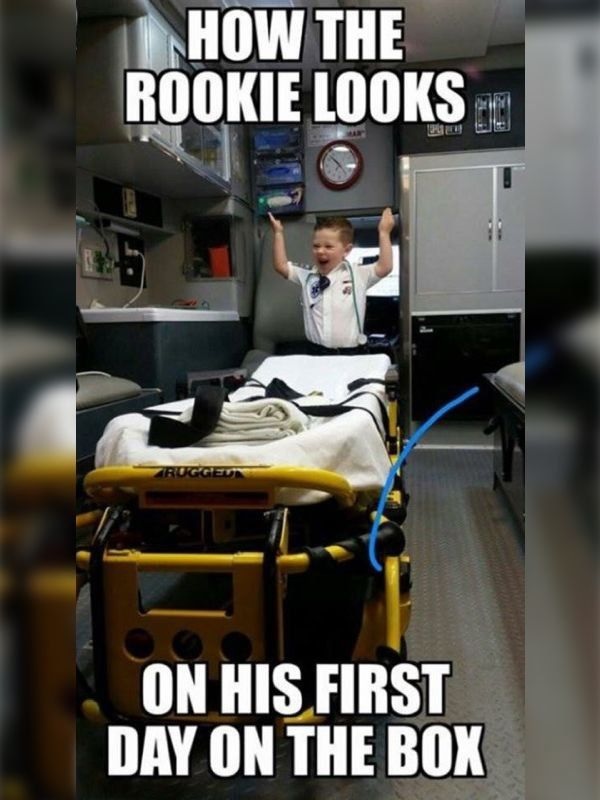
Let me just start this off with, WE HAVE ALL BEEN THERE!!! I don’t care what anyone says, no one came out of EMT or Paramedic school knowing everything and not doing at least one or two of the things we are about to discuss.
YOU’RE GOING TO DO FINE, TAKE A CHILL PILL!!!

Crap… What was that dosage again???
Alright, first day on the truck… Crap, I forgot to say “BSI Scene Safe” at the beginning of the blog… Is that a critical fail, or ummm, I mean am I fired???
So yeah, I’ve actually seen a brand new EMT say “BSI scene safe” as we walked into a patient’s house. At first I thought he did it as a joke, but the look he had on his face when I looked at him told me otherwise. It took everything in me to not die of laughter right there. This simple phrase is literally DRILLED into our heads, and nothing seems to get it out lol. So yeah, please don’t actually say it when you arrive on scene. By no means am I saying not to DO it, just don’t say it that way. Make sure your scene is safe and that you are wearing your correct PPE, but please don’t put your hands up and say “BSI scene safe” like they teach in class.
So besides fighting the urge to say “BSI scene safe” on every call, what other things do you need to know for your first day working on an ambulance? Let’s just make this blog into a list, for ease of reading shall we:
- It’s your first day on the truck, and you are TERRIFIED. Well, don’t be. There’s a reason it’s called “practicing medicine”. We all have made mistakes to get to where we are today. Don’t think for one instant that every “perfect EMT/Medic” came out of school that way. We have ALL ran emergent down the road and forgot our lights, or started an IV and forgot to occlude the vein, or even forgot to remove the nasal cannula from the truck’s O2 before pulling the patient out of the truck. Don’t be afraid to mess up. Rely on your partner and you’ll get through it. It’s going to be rough at first, but then one day you’ll wake up and say to yourself “you know what, I’ve got this”, and you’ll never look back
- Forget all of the TV shows and movies that you’ve seen EMS in. It is not like that at all. As my wife can tell you, there isn’t a “medical scene” that we watch on TV or at the movies where I am not in uproar for all of the mistakes. WHAT THEY PORTRAY ISNT CORRECT!!! We’ll touch on this one again in just a little bit.

- So you’re ready to start your shift and you feel prepared. You have your tactical belt, tactical trauma sheers, three pen lights, a finger pulse oximeter, a glove pouch with four extra sets of gloves, a pocket mask, and God knows what else. You have more equipment strapped to your belt than the truck has. Now, go ahead and take all of that off before someone sees you. Nine times out of ten, you won’t need half of the items I just listed. You’ll actually use your trauma sheers on occasion, but mostly to open bags of chips and other junk food in the EMS room. Every phone now a days has a camera that makes a penlight useless on an ambulance, not to mention the ones on the truck NEVER work. A pulse ox can be useful, but after your first one gets destroyed or covered in some unknown substance, you’ll be a little less likely to use your personal equipment on the truck. The glove pouch is nearly useless, and you’ll probably get tired of folding gloves back into it after every call. There is literally no reason in the world to use a pocket mask if you have a bag-valve-mask at your disposal, do I really need to explain this one? So yes, be prepared, but you don’t need to carry EVERY thing on you – you have a truck for a reason.
- A manual sphygmomanometer, commonly known as a “BP Cuff” reads pressure that is needed to be applied to a patient’s arm (or leg) to determine the blood vessels pressure. This reading comes in the form of “mmHg” or millimeters of mercury. So why am I bringing this up? Well, an automatic BP cuff is able to give a read out of odd numbers; however a manual cuff only has readings in even numbers. So when someone says their patient has a BP of 121/81 on a manual cuff, this is incorrect. This is a tell-tale sign that someone is “guessing” a BP reading. So, stick to even numbers. Speaking of BP readings, don’t just use a BP of 120/80. This is the “textbook” reading for an adult patient’s BP, and is the go-to number for anyone fibbing their patient’s vitals.
- So let’s get back to that whole TV/Movie issue. Have you seen a movie where the patient is in cardiac arrest, yet after a round of CPR they just magically “wake up” and carry on like nothing happened? THIS. DOES. NOT. HAPPEN! Nine times out of ten, you won’t achieve Return of Spontaneous Circulation (ROSC), or simply put the patient regains a heartbeat. This isn’t an exaggeration; it is EXTREMELY rare for a patient to regain a heartbeat following cardiac arrest. Now this isn’t to say that this is always the case. With improving science and medicine we are seeing increased rates of survival of these patients, but nothing like you see on TV/movies. In my entire career, I have only one time had a patient who was SEMI-verbal following cardiac arrest, and that will probably remain to be the only one in my entire career. These are SICK patients; they don’t just recover in an instant. This may sound grim, but don’t keep your hopes up. Do the best you can, because you are trying to save someone’s life, but also don’t beat yourself up if they don’t make it.
- And finally, let’s talk about one more thing that doesn’t happen like it does in TV/movies. We have all seen shows where a car is on fire and then explodes in a ball of flame killing everyone inside and round the vehicle. Well, that’s complete BS. Cars don’t explode like that. Yes, they can be filled with gasoline which is extremely flammable, but it won’t cause an explosion, the flames will just get bigger at a reasonably slow speed. Now, what can explode is if there is a hazardous material being stored in the vehicle, like an 18-wheeler. That does have potential to explode, but not every day vehicles. Something I do want to address, however, is the wheels and bumpers of the vehicles. If you ever watch ACTUAL firefighters (not on the TV), you will never see them approach a vehicle fire in beside the wheels or in front of the bumpers. The reason is that these parts are under INSANELY high amounts of pressure, and when they are on fire have been known to fly off of the vehicle at high rates of speed. I personally have worked a call where a passerby was killed because a wheel was ejected from a burning car. I also have a friend who lost a leg because the bumper of a vehicle came off during a car fire and hit him straight in the knee. These things are no joke. Luckily most of our readers are strictly EMS, and hopefully won’t have to deal with these issues, but it is still good information to know. Safety should always be your number one concern. BSI scene safe right??

So yeah, that’s just a few examples of things you need to know for your first day. There isn’t So yeah, that’s just a few examples of things you need to know for your first day. There isn’t enough time in the world to prepare you for EVERY call you will respond to. You just need to learn and adapt over time, and it’ll come to you. Don’t stress out, we’ve all been there before. And for the things that you don’t know, there’s always trusty WebMD


Loved the article
LikeLike