
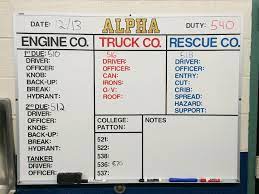
I know this is an EMS blog, but let’s talk about the fire department for a second. When the fire department gets a call for a structure fire, multiple units respond to the call. Typically 4-5 fire engines, a rescue truck, a ladder truck (or two) and a battalion chief respond, or some variation of this layout. What you might not know though is, those 4-5 fire engines already have pre-designated jobs depending on what order they arrive. This designation can also change without any verbal commands from the acting incident commander. Typically the first due fire engine is interior fire attack, the second engine is in charge of water supply (connecting the engine to the fire hydrant) and third engine is in charge of “RIT” or Rapid Intervention Team, the fourth is search and rescue, and the fifth is your secondary interior attack crew. On top of that, every “seat” in the truck has a different assignment as well. The driver is in charge of pumping water from the truck to the fire attack crew, the driver’s side rear seat is for the person “catching the hydrant” and assisting the driver establish water connections. The front passenger is typically an officer who is either incident command, or can go in with the person sitting behind them as the first interior fire attack crew. Now, this changes from department to department and even chief to chief, but it is usually something similar to this setup.
The reason for this is to help with unified command as well as creating a clear cut plan to calls that they run on a daily basis. I bring this up, because EMS needs to create a similar “plan of attack” on our calls. One of the best examples of this is King County EMS, in Seattle, Washington. King County EMS practices what is called “Pit Crew CPR” which is slowly becoming national standard in part to the American Heart Association’s recent adoption of the same system. Pit Crew CPR is a method of running a cardiac arrest in a way that is similar to racing teams pit crews. Each provider has an assigned role to complete; therefore, all tasks are completed in a timely manner. Now this may seem like a common sense way of running an arrest; however, according to AHA’s statistics, these tasks are not being preformed correctly or in a timely manner. Accord to AHA, King County EMS has a 56% cardiac arrest survival rate, which is quite a bit higher than the national average of 12% in the out-of-hospital setting. Now, Pit Crew CPR is only a portion of King County EMS’ success. Another reason for their high numbers is the amount of personnel that respond to these calls (nearly double the national standard) and their use of the Rescue Pod System, which is a topic for another day.

Freelancing is defined as individuals working independently to complete tasks without the knowledge or consent of the incident commander. This practice can be detrimental not only to our patient’s, but to our fellow crew members as well. What I’m proposing is the opposite of freelancing. What I’m suggesting is services coming up with protocols and courses of action in regards to calls that to which we commonly respond. While some services have protocols that detail EVERY action that should be performed on a given call, others are given a list of skills and medications that they are allowed to administer and the crew members are to choose the best course of action at the time of need. Yet again, I feel like this is a dangerous practice. There are way to many variations of skill level and education for this type of system.
So here is an example of what I’m talking about. If you’ve followed my blog for any amount of time, you know that I am a fan of delegating tasks to responders that I am supervising. This is everyone from my partner of the day, to fire department crews that first respond, to even police personnel and bystanders on scene. If we are responding to a cardiac arrest, most of us know the AHA cardiac arrest algorithm like the backs of our hands, but what about the little old lady who fell and hit her head? Or the young man who is having an asthma attack? Or even a frequent flier who just wants a ride to the hospital so he can get a couple hours of sleep in a hospital bed?

As you arrive on scene, go ahead and try to think of the tasks at hand. Ask your partner to get a baseline set of vitals while you perform a rapid assessment of the patient. If the call is respiratory in nature, go ahead and have a firefighter in charge of oxygen administration, whether it be a nasal cannula, non-rebreather, or even bag valve mask. Obviously this is going to be easier done if you run with the same crew every call, but that doesn’t mean it can’t be done even if you don’t.
Eventually you will find a good “click” of how you want to run calls. But here is my suggestion, use the resources available to you. That includes everyone from your partner, to the fire department crew, your supervisor (if available), police officers, and finally family and bystanders that are not emotionally incapable of helping at the time.

I had a very good medic once tell me that you will run every call four times. The first time will be a complete $h!t show. The second time will be slightly better, but still pretty bad. The third time you will do a good job, but still miss some of the minor stuff, and the final time you will knock it out of the park. At the end of the day, just keep two things in mind:
1). It is not your emergency. You need to be the CALM on scene.
2). You are in charge, do what you are trained to do and you will give the patient the best outcome that is possible for them.

 Medic Minute