Ever heard the phrase “You don’t have to reinvent the wheel”? Well in EMS; the red-headed stepchild of the medical field, you may have to do just that…
One of the most unique parts of our career is that fact that we are out on the road and we don’t have an entire medical staff right there. At times that is nice, however, when you are out of supplies it would be REALLY nice to be able to pull equipment from a supply cabinet or another patient room if need be. We unfortunately, don’t get have that option. For the most part, you have the bare minimum required by your state (and sometimes even less). So what are you to do when you don’t have a very much needed piece of equipment??? Well, it’s simple…
YOU IMPROVISE!
Very much like Bear Grylls, you need to use what’s around you to improvise, adapt, and overcome any situation you are placed in. Like I have said in numerous other blogs, this could seriously mean the difference of life or death for our patients. So what do I mean?
Well, let me start with my personal favorite, the Kendrick Extrication Device, more commonly known as the “KED”. Now we all know this device from our NREMT Psychomotor Skills Testing, but VERY few have actually used this piece of equipment in the field. The reason for that is, the KED was not meant for us…
SAY WHAT?!?!?!
The KED was invented in 1978 by Richard Kendrick for the extrication of open wheel Indianapolis race car drivers. Here’s a fun fact for you: in 2015 an article in the Journal of Paramedic Practice called out the legitimacy of the KED stating there is a “lack of evidence to support its use”. I’m not going to go into a whole discussion about pieces of equipment that we are required to have on our trucks that shouldn’t be used as often as they are (*cough BACKBOARDS *cough). But here is the kicker, I don’t think the KED should be removed, and here is why: Did you know that the KED makes a great hip stabilizer for a suspected/confirmed pelvic fracture??? Yep, flip that bad boy upside down and place it around the patient’s hip. It will immobilize the hip better than any sheet method would, and makes it MUCH easier to slide the patient over to the ER bed, without putting the patient through even more pain. I can’t tell you how much I love to do this in front of firefighters who have no clue what I’m doing. They look at me like I have three heads when I pull it off the truck, but most are believers after it’s been applied.

This is just one of MANY ways you can improvise for missing equipment. So let’s go over just a few easy ones that I personally have had to use in my career.
- Don’t have a constricting band to start an IV, or maybe you don’t have a tourniquet for an arterial bleed? Try a manual BP cuff! Blow it up past 200mmHg and you should have more than enough back pressure to start your IV, and hopefully enough pressure to stop an arterial bleed. Arterial bleed still flowing? Add another manual BP cuff. By most state’s law, you should have more than one on your truck, and I’m sure the fire department can loan you one off of their truck if not.

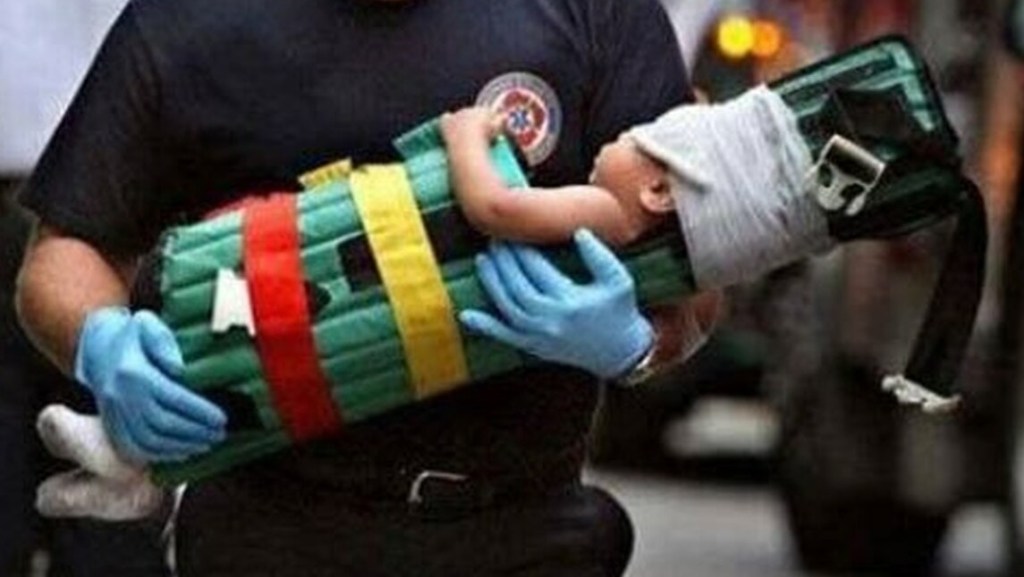
- Have a pediatric patient who you need to fully immobilize, but your service doesn’t carry pediatric backboards and they are too small to fit on your adult backboard? Well, bust out that trusty KED again!! Flip it upside down and you have a great hard surface to immobilize your little patient!
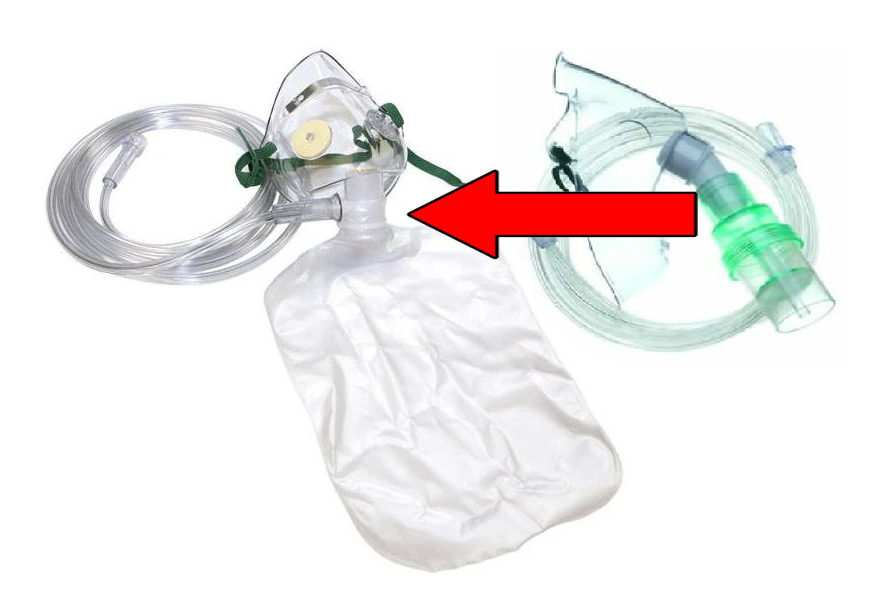
- It’s Croup season and you just used your last pediatric nebulizer mask. How are you going to give Racemic Epi? That’s an easy one! Just take the fluid chamber off of an adult NEB mask, and remove the bag off of a pediatric non-rebreather mask. The canister will fit the NRB mask, however you may need to secure it in place with tape.
- Went through EMS school and thought every truck was fully stocked with those fancy orange splints and SAM splints? Think again! ANY rigid object can become a splint. I’ve used everything from an old glove box, a composition notebook, one of those “we buy houses” signs, to even a piece of the patient’s car that was broken during an MVC. The world is your playground, get creative! Lol

- Have a hypoglycemic patient with a BGL of 40, but you can’t seem to find your oral glucose? You could always give them D50 (or D10) if you’re ALS, but if they’re alert and oriented and able to follow commands, you could give them a glass of orange juice. The juice will absorb faster into their blood stream than the oral glucose and they will definitely prefer the taste of the OJ over the “grape flavored” mess. Now, this isn’t the best idea if the patient is planning to go to the ER, due to aspiration concerns in the event of surgery. But most diabetics won’t want to go to the ER, and would rather just eat a meal once their BGL has returned to a sustainable level.

- Have a patient who had an exposure to Magnesium and they’re eyes are burning? Well, you can’t use sterile water or normal saline because water reacts to Magnesium, so what do you do? Place a nasal cannula on the bridge of their nose facing the eyes. This can help irrigate the eyes until you can get them to the ER

Those are just a couple different things that can be used for alternative uses in the back of the truck. This same method can be applied to medications, but I wouldn’t advise going down that road – leave that to the doctors!
I have personally done every one of these examples in the back of my truck, but unfortunately I can’t take credit for them. When I went through EMT school, however long ago that was, I had a VERY seasoned medic that taught my class. He worked for an ambulance service that loved to cut corners in every way possible, and most of the time it was in the equipment replenishment department. I’m not saying these are places that you NEED to work to get the required “in-the-field” training, however you can learn a lot from personnel that have had to get creative with treatments. And like I said in the beginning, one of these “MacGyver moments” could actually save a patient’s life one day, so let’s all put on our creative hats and get some work done with what we have!
 Medic Minute